
Why 2025’s Safe Harbor Window Matters More Than Ever
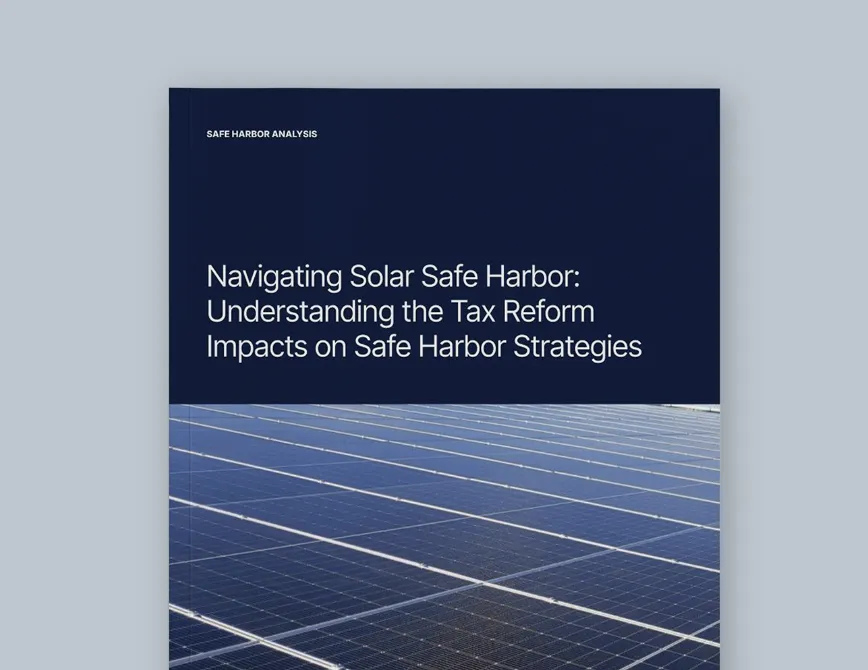
Safe Harbor remains a powerful strategy for securing tax benefits. This whitepaper with Cherry Bekaert explains new IRS guidance, FEOC considerations, timeline relief, and how to preserve full project value.
Why 2025’s Safe Harbor Window Matters More Than Ever
As we approach the end of 2025, many organizations, investors, and solar partners are asking the same question: What do the Safe Harbor deadlines really mean—and how should we be preparing before year-end?
I recently sat down with Brightwell CFO, Trey Raymer, for an in-depth conversation about this very topic. Together, we unpacked how the One Big Beautiful Bill Act (OBBBA), the August executive order, and the most recent IRS guidance have created both opportunity and urgency for solar development in the months ahead.
Whether you’re a nonprofit looking to control rising energy costs, a solar installer positioning your 2026 pipeline, or an investor seeking stable, high-impact returns, understanding Safe Harbor is essential. The decisions made between now and December 31 will determine who locks in the strongest incentives—and who misses the window.
Our discussion walks through what Safe Harbor actually is, how it works, and how Brightwell is applying it across our network to preserve value for partners nationwide. I encourage you to take a few minutes to watch the full conversation below—it’s a concise, practical overview of what’s changing and what you can still do before the year closes.
What Safe Harbor Really Means
In simple terms, Safe Harbor establishes when a project officially “begins construction” under IRS rules. By meeting that standard in 2025, you fix the tax benefits in place even if construction and installation occur later.
There are two main ways to qualify:
- The 5% Safe Harbor — A payment or incurred cost equal to at least 5% of the total project price must go toward eligible solar materials or components.
- The Physical Work Test — Tangible construction activity must begin, such as installing racking or integral system components (not just preliminary site work).
For most distributed-generation solar projects—schools, churches, food banks, and community organizations—the 5% Safe Harbor remains the most practical path. It applies to systems under 1.5 megawatts, which covers the majority of on-premise installations.
The Advantage of Acting in 2025
The rules are clear, and the deadlines are firm. Projects that begin construction by December 31, 2025 lock in today’s:
- 30% Federal Investment Tax Credit (ITC), with potential bonus credits up to 70%
- 100% bonus depreciation
- Exemption from the new Foreign Entity of Concern (FEOC) restrictions on Chinese-sourced materials
- Eligibility for a 10% Domestic Content Bonus for projects meeting a 45% U.S.-made materials threshold
After January 1, 2026, FEOC compliance becomes mandatory and far more complex—potentially disqualifying projects that rely on globally sourced components. Safe Harboring now removes that uncertainty and preserves today’s cleanest path forward.
For investors and organizations alike, Safe Harboring a project in 2025 ensures a compliant, incentive-protected foundation for years to come.
How Brightwell Is Preparing
At Brightwell, we’ve taken a proactive approach. Throughout 2025, our team has initiated over 100 Safe-Harbored projects, representing more than $160 million in development value.
Each project has:
- Purchased qualifying energy property
- Satisfied the non-refundable payment requirements
- Documented the beginning of construction in accordance with IRS Notice 2025-42
These projects are now effectively “on the shelf,” ready to be installed through 2029 while maintaining 2025’s favorable incentive profile.
To validate every detail, Brightwell partnered with Cherry Bekaert and renewable energy legal experts. Together, we’ve ensured a foundation for our investors, installers, and nonprofit clients nationwide.
Supporting Our Network of Installers
Our mission has always been to make renewable energy accessible to organizations serving the public good. Through partnerships—especially with Amicus Solar Cooperative installers—we’re helping regional EPCs understand how to Safe Harbor their own pipelines.
This not only ensures that trusted local installers can continue serving their communities under the current incentive structure, but also expands the pipeline of eligible Brightwell projects that impact nonprofits across the country.
The Broader Energy Context
Electricity demand in the U.S. is rising faster than at any point in recent memory. The growth of AI data centers, electrification of vehicles, and industrial expansion are all driving new load. Utilities are warning of capacity shortages and rate increases, and nonprofits—often operating on tight budgets—are among the most exposed.
Solar offers a scalable, rapidly deployable solution. By leveraging Safe Harbor today, organizations aren’t just locking in tax incentives; they’re securing long-term stability and predictable energy costs for decades to come.
Act Before the Window Closes
The Safe Harbor opportunity won’t last.
- December 31, 2025: Final date to lock in current ITC, depreciation, and FEOC-free status.
- July 4, 2026: Secondary deadline—projects can still Safe Harbor, but will face stricter domestic-content and FEOC rules.
If you’re an investor, this is your moment to secure Brightwell projects with preserved tax advantages through 2029.
If you’re a nonprofit or institution, it’s your chance to capture today’s economics before they narrow.
If you’re a solar installer, Safe Harbor now ensures your pipeline remains viable under tomorrow’s rules.
At Brightwell, we exist to make these opportunities accessible and meaningful—for our partners, investors, and the communities they empower.
Learn More
For deeper guidance, download our vetted Safe Harbor Whitepaper, co-authored with Cherry Bekaert.
Perspectives on modern operations and smart growth.


Let’s chat to see how we can unlock new opportunities for impact, together.